
- Product Types
- Prices Types
- Adding Products
- One Time Pricing
- Subscription Pricing
- Subscription Trials Setup
- Installment Pricing
- Donation / Pay What You Want
- Inventory Management
- Product Variants
- Variant Images
- Digital Downloads
- Change Product Availability
- Product Collections
- First-Time Payment Discounts
- Manage Product Access
- Create Product With Free Trials
- Charge Set Up Fee on Trials
- Product List
- Product Pages
- Product Content
- Custom Buy Links
- Product SEO
- Change Permalinks
- Custom Fields
- Related Products
- Price Boost
- Product Bundle
- Product Reviews
- Product review shortcodes
- Test Mode/Payments
- Edit & Customize Form
- Change Form Template
- Delete SureCart Forms
- Add Checkout Form
- Checkout Form With Gutenberg
- Checkout Form in Elementor
- Custom Thank You Page
- Create Donation Form
- Customize Confirmation Popup
- Include Coupons in URLs
- Pre-Fill Checkout Fields
- Change Checkout Texts
- Password Field in Checkout
- Default Country Code
- Add Terms to Checkout
- Conditional Block Checkouts
- Remove Coupon Field
- Hide Quantity Option
- Disable Quantity Editing
- Disable Item Removal
- Country Specific Purchases
- Update Store Details
- Dark Mode
- Orders & Receipts
- Manage Slide-out Cart
- Customers Section Overview
- Create Customer
- Delete Customer
- Update Customer Details
- Edit Invoice Details
- Create Shipping Profiles
- Manage Shipping
- Disable Payment Processor
- Manage Store Notifications
- Manage PayPal Branding
- Transfer Store
- How to Download SureCart Purchase Invoice
- Vault – Redeem & Manage Your SureCart Pro Plan
- Enhance Performance Settings
- Invite Team Members
- Enable Spam Protection
- Sync WP Users
- User Roles & Permissions
- Export Data
- Clear Test Data
- Manage Email Notifications
- Remove User Roles
- Remove Plugin Data
- Delete Store
- Delete Business & User Account
- Guest checkout
- Switching Store Currency
- Fix View Order Button
- Fix Express Payment Buttons
- How To Stop Sending WooCommerce Notifications via SureCart?
- Fix PayPal Test Connection
- Fix Sign-In Loop
- Fix Order Confirmation Redirect
- Fix Divi Bullet Point Issue
- Fix Customer Dashboard
- Fix JSON Response Error
- Failed Payment Behavior
- Fix Stripe Zip Code Error
- Fix "Product Can’t Be Blank"
- Troubleshooting Guide
- PayPal IPN Warning Emails
- Caching Configuration for SureCart
- Why iDEAL Might Not Appear in Your Checkout
- Compatibility Guide
- Troubleshooting Stripe Payment
- Fix – SureCart store disconnected
- Configuring LiteSpeed Cache for SureCart
- Webhook Troubleshooting
How to Delete a Customer in SureCart
Any customer can be deleted from the store, including customers who have placed orders, started checkouts, or hold active subscriptions. This document explains how to delete a customer, what data is removed, and what is retained. Deleting a customer is a permanent, irreversible action that also removes the customer’s associated records.
Important Note
Deleting a customer is permanent and cannot be undone.
When a customer is deleted, their associated checkouts, orders, line items, invoices, subscriptions, purchases, and balances are also permanently deleted within approximately 24 hours. This action is irreversible. There is no option to undo it and no way to recover the data afterward. Exporting any data that needs to be retained before deleting is strongly recommended.
Requirements
- WordPress admin access with permission to manage SureCart customers
- SureCart installed, activated, and connected
What Happens When a Customer Is Deleted
Deleting a customer is processed in two stages:
- Immediate removal: The customer is removed from the Customers list right away.
- Scheduled purge (within ~24 hours): A background process permanently deletes the records associated with the customer.
Data that is permanently deleted:
- Checkouts
- Orders and line items
- Invoices
- Subscriptions
- Purchases
- Customer balances
Data that is retained:
The payment, charge, and refund ledger is retained for audit purposes. These records are detached from the deleted customer rather than removed, so financial history remains available even though they are no longer linked to a customer profile.
There is no block for customers with activity. Unlike previous versions of SureCart, deletion is no longer prevented for customers who have made purchases. Any customer can be deleted, and the associated data is purged regardless of order or subscription history.
“Cannot Delete Record Because Dependent Checkouts Exist”: Is This Still Applicable?
No. Older versions of SureCart blocked deletion for customers who had a checkout or purchase, returning the error “Failed to delete customer. Cannot delete record because dependent checkouts exist.”
That restriction has been removed. Existing orders, checkouts, or subscriptions no longer block deletion. Instructions stating that a customer cannot be deleted after making a purchase are outdated and no longer reflect current behavior.
Before Deleting a Customer
Because the action cannot be reversed, the following steps are recommended before deleting:
- Export any customer or order data that needs to be retained. SureCart can export Customers, Orders, Subscriptions, Charges, Refunds, Line Items, and more as CSV files. Refer to How to Export Data.
- If only active subscriptions need to be stopped (not the customer record), cancel the subscription instead of deleting the customer. Cancelling stops billing while keeping the customer and their history intact.
- Confirm that the customer has no active subscriptions that should continue. Deleting the customer deletes the subscriptions, which stops future billing and access.
- Confirm that no pending refunds or disputes depend on the order data that will be purged.
Deleting a Single Customer
- Go to WordPress Dashboard → SureCart → Customers.
- Click the customer to open the Edit Customer page.
- Click the three-dot menu in the top-right corner, next to Save Customer.
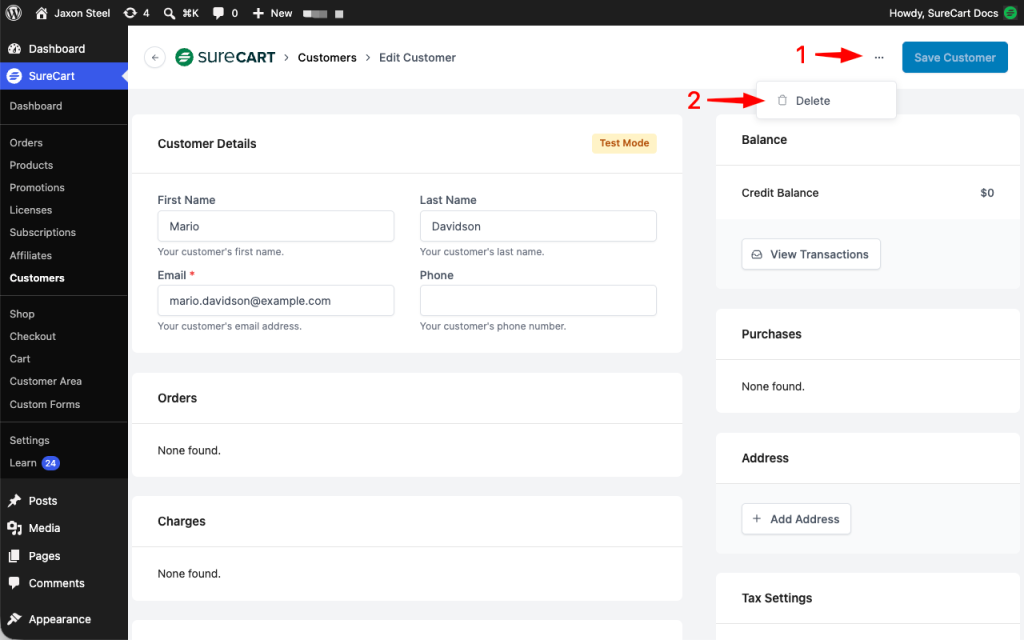
- Select Delete.
- Confirm the deletion when prompted.
Expected outcome: The customer is removed from the Customers list immediately. The associated records are permanently deleted within approximately 24 hours.
Deleting Multiple Customers (Bulk)
- Go to WordPress Dashboard → SureCart → Customers.
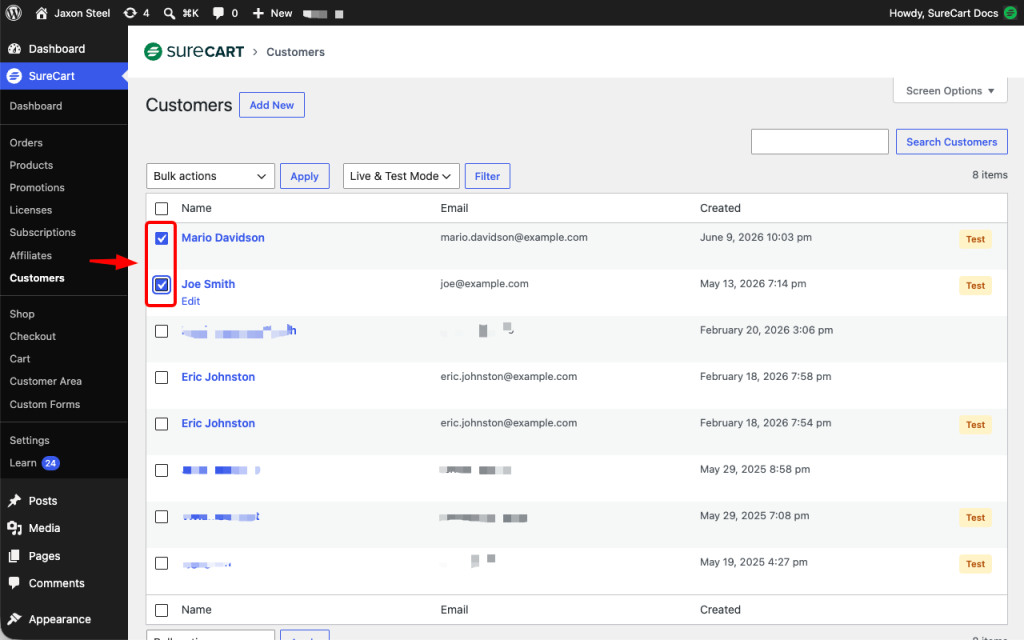
- Select the checkbox next to each customer to delete.
- In the Bulk actions dropdown, select Delete permanently.
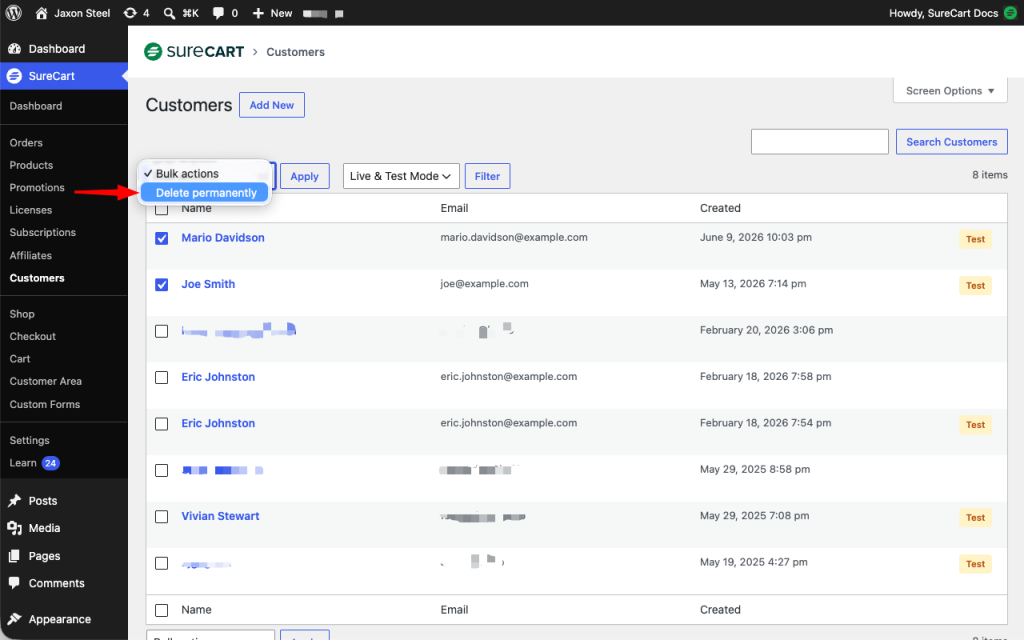
- Click Apply.
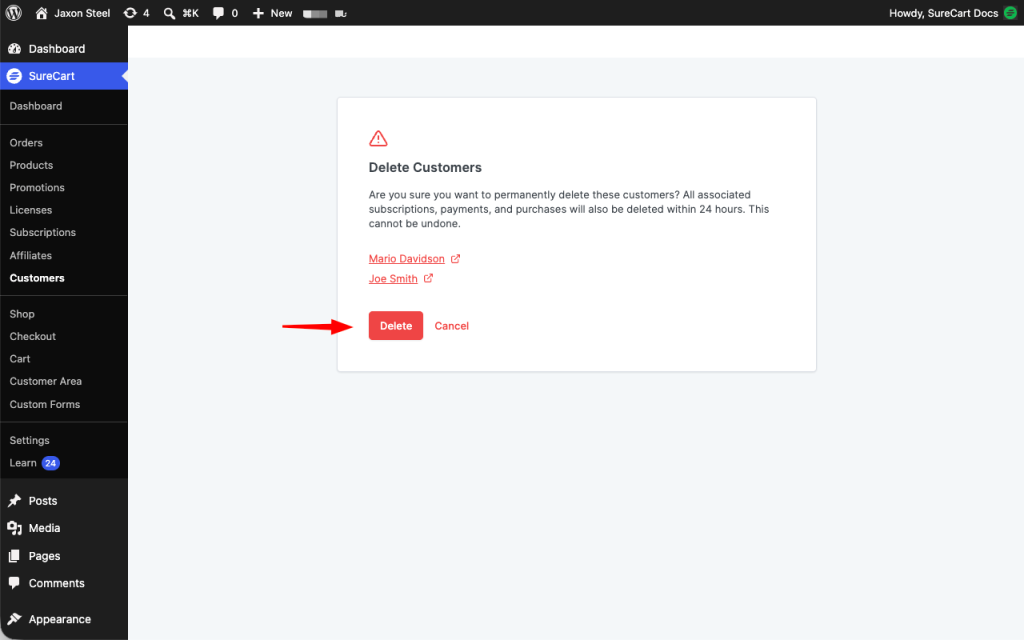
- A confirmation screen lists the selected customers and states that all associated subscriptions, payments, and purchases will also be deleted within 24 hours and that the action cannot be undone.
- Click Delete to confirm.
Expected outcome: A bulk action summary is displayed (for example, “Bulk Action Summary: 1 succeeded”), and the selected customers are removed from the list. The associated records are purged within approximately 24 hours.
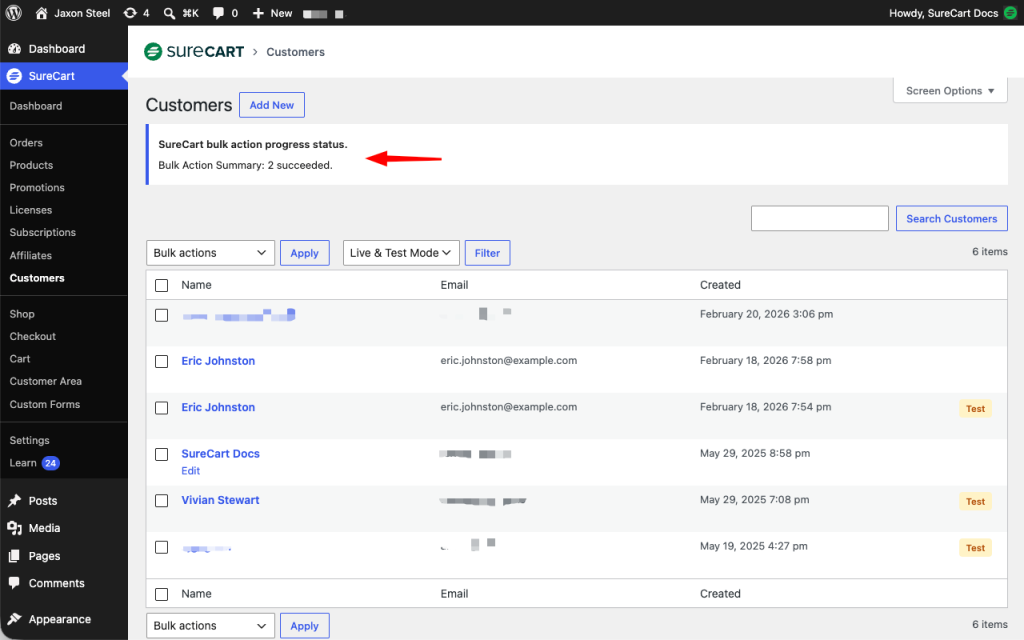
Bulk deletion has no per-customer skip. Every selected customer is deleted. There is no option to exclude an individual customer once the bulk delete is confirmed. Reviewing the selection on the confirmation screen carefully before clicking Delete is essential.
Deleting a WordPress User vs. a SureCart Customer
A WordPress user account and a SureCart customer are two separate records:
- SureCart customer — The customer profile in SureCart, containing orders, subscriptions, purchases, and related data. This is what is deleted (and purged) using the steps above.
- WordPress user — The WordPress account (with the SureCart customer role) that may have been created during checkout. This is managed from the WordPress Users section.
Deleting a WordPress user from the WordPress Dashboard → Users removes the WordPress account but does not delete the SureCart customer or trigger the data purge. Conversely, deleting a SureCart customer does not automatically delete the associated WordPress user. The two actions are independent and must be performed separately if both records need to be removed.
Deleting Test Customers
Customers created during test-mode transactions can be removed in the same way. To clear all test data at once instead of deleting customers individually, refer to How to Clear Test Data.
Notes and Limitations
- Deletion is permanent and cannot be undone. There is no user-facing recovery option after a customer is deleted.
- The data purge occurs within approximately 24 hours of the deletion, not immediately. The customer disappears from the list right away, but the associated records are removed by a scheduled background process.
- Deletion is not blocked for customers with orders, subscriptions, or other activity.
- The payment, charge, and refund ledger is retained for audit purposes and detached from the deleted customer.
- Bulk deletion deletes every selected customer with no per-customer skip during the operation.
- Deleting a SureCart customer and deleting a WordPress user are independent actions.
Related Documentation
- How to Export Data
- How to Clear Test Data
- Customers Section Overview
- How to Update Customer Details
- How to Refund an Order
FAQ
We don't respond to the article feedback, we use it to improve our support content.