If you’re selling digital products in India, WooCommerce isn’t your only WordPress option, and for digital-only sellers, it’s often not the most cost-effective one either. This guide compares SureCart, WooCommerce, and Easy Digital Downloads (EDD) on real Indian pricing, Razorpay and UPI support, and what it actually costs to run a license-gated or subscription-based digital storefront for a year.
Short version: if you want to start with zero upfront cost and simple downloads, the free tier of any of the three will do. Once you need licensing, subscriptions, or bundles, SureCart is usually the most cost-effective way to get all three without stacking extensions; EDD comes close if you’re willing to pay for its bundled Professional tier upfront, and a fully stacked WooCommerce setup is the most expensive path.
Who This Guide Is For
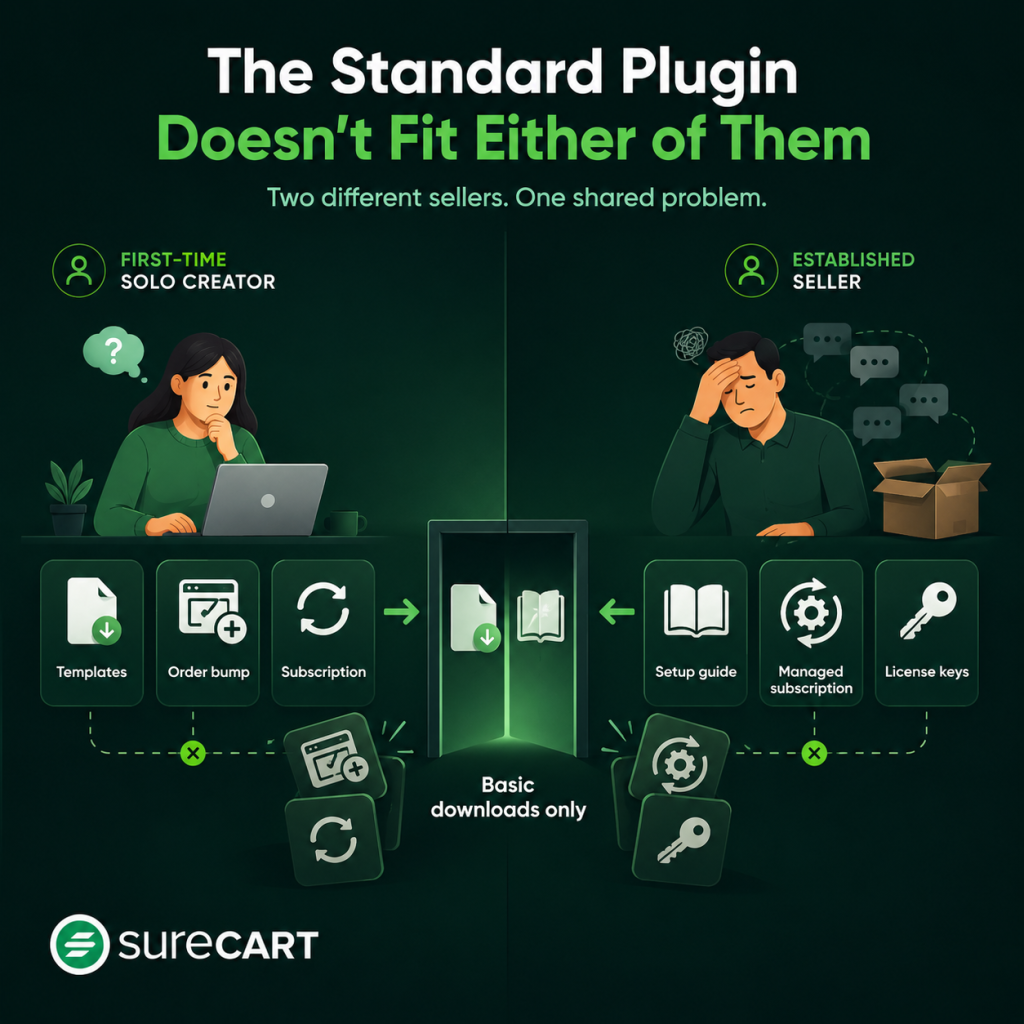
This guide is written for two kinds of sellers, and we’ll follow both of them through every section.
Ananya, The First-Time Builder
Ananya is a solopreneur about to launch her first product: a set of Notion planner templates. She hasn’t picked a platform yet, and she doesn’t want to get this wrong on her first try.
Beyond the templates themselves, she’s already planning two more revenue lines: a higher-ticket “Notion Second Brain” setup package she wants to offer as a checkout order bump, and a monthly consulting subscription for buyers who want ongoing help.
Her priority is a cost-effective way to get all three live without stacking a pile of separate tools, with zero upfront cost if possible, and nothing that boxes her in if the business grows.
Rohan, The Established Digital Seller
Rohan has been selling AI agents for two years, first on Gumroad, then increasingly through Instagram DMs. He’s past the “does this work” question. What’s eating him now is Gumroad’s cut and the hours he loses manually walking buyers through setup over DM.
He wants his own branded storefront, with a self-serve setup guide buyers can purchase outright, a subscription for buyers who want him to deploy and manage their agents, license keys for the agent products he’s built and packaged for resale, and a real customer dashboard, not a marketplace listing.
Everything in this guide is written for sellers like Ananya and Rohan: people selling digital products specifically, downloads, templates, licensed software, courses, memberships, and subscriptions. Not physical retail, not marketplace resale, not an offline store moving online. If that’s you, keep reading.
The Payment Reality in India That Most Guides Skip
Before any feature comparison matters, there’s a payments problem almost nobody mentions upfront.
Stripe is invite-only for new India-based merchants, confirmed directly on Stripe’s own support site as of this writing. Indian businesses can’t sign up through the website and instead have to request an invite, with Stripe currently prioritizing a select number of businesses.
That’s a real constraint, and it applies no matter which of these three platforms you choose. Stripe being “supported” on a pricing page doesn’t mean you can actually get an account, so confirm your own eligibility and supported payment methods directly with Stripe before you build a launch plan around it.
Razorpay is the practical answer for Indian sellers, and UPI is the payment method your buyers will actually reach for. This matters more for digital products than almost any other category, since a lot of Indian digital buyers are paying ₹299 to ₹1,999 for a template or an ebook, and UPI is how that kind of purchase happens.
SureCart added Razorpay in February 2026, connected through a simple account authorization rather than API keys, and added Razorpay UPI for recurring subscription payments in May 2026. WooCommerce and EDD both support Razorpay too, but through a separate official plugin rather than something built-in.
Razorpay’s own fee is 2% on UPI, cards, net banking, and wallets, plus 18% GST charged on that fee, which works out to roughly 2.36% effective, per Razorpay’s own published pricing. That’s Razorpay’s cut, not a platform cost, so it applies no matter which of the three platforms you choose.
One detail worth knowing: Razorpay normally adds another 0.99% on top for recurring or subscription billing, but that extra charge doesn’t apply if you’re running subscriptions through our own built-in SureCart subscription engine rather than Razorpay’s native recurring-payments feature directly.
Limited-time offer: as of July 2026, we’re running a promotion that waives our own platform transaction fee for merchants using Razorpay on the free Launch plan. During the promotion, you’d pay only Razorpay’s roughly 2.36% effective fee and nothing extra to us, instead of our usual 2.9% on top.
This is explicitly time-limited. If you’re reading this after July 2026, email support@surecart.com to confirm whether the offer is still valid before assuming it’s still running.
Pro Tip: if you already have an invited Stripe account, keep it as a secondary gateway for international card buyers. Just don’t build your India launch plan around getting one.
Plan & Pricing Snapshot
| Platform | Free Plan | Paid Plan (Annual) |
| SureCart | Launch: $0 + 2.9% transaction fee | Pro: $199/year, no transaction fee |
| WooCommerce | Core plugin: $0 (extensions sold separately) | À la carte, see the table below |
| Easy Digital Downloads | Core plugin: $0, downloads only | Professional: $299.50/year, or All Access: $499.50/year |
One thing worth flagging early: SureCart and EDD both bill in US dollars, not rupees. WooCommerce’s extensions, by contrast, are priced in INR when you buy them from India.
Any dollar-to-rupee conversions in this guide use an illustrative rate of roughly ₹95.5 per $1 (approximate), as of July 2026. Exchange rates move, so treat these conversions as directional, not exact.
SureCart also offers a one-time lifetime option for the single-store Pro plan: $699 paid once, or split into 11 monthly payments of $69, with no transaction fee and no recurring annual bill afterward.
This guide’s cost scenarios below use the $199/year recurring price, since that’s the closest apples-to-apples comparison to WooCommerce’s and EDD’s own annual costs. Still, if you already know you’ll be sticking with us for more than three years, the lifetime option is worth pricing out separately.
Feature-by-Feature Breakdown
Here’s where the real decision gets made, feature by feature. Each cell is deliberately short: “Included” means it’s built in at no extra cost, a rupee or dollar figure means that’s the add-on price, and “Unclear” means we couldn’t confirm it.
The footnotes below provide additional context.
| Feature | SureCart | WooCommerce | EDD |
| Digital file delivery | Included | Included | Included |
| License keys | Included | Add-on, ₹17,181/yr | Included (Professional and All Access only) |
| Subscriptions | Included | Add-on, ₹26,780/yr | Included (Personal Tier and above) |
| Product bundles | Coming Soon | Add-on, ₹7,583/yr | Included (Extended tier and above) |
| Memberships | Add-on, $69/yr | Add-on, ₹19,101/yr | Included (Extended tier and above) |
| Razorpay + UPI | Included | Free plugin | Free plugin |
| Checkout, upsells, cart recovery | Included | Add-on, ~$189/yr | Included (Personal Tier and above) |
| GST invoicing | Custom Integration | Add-on plugin | Custom Integration |
| Migration in | Supported | Manual | Manual |
| Migration out | Included | Add-on Plugins | Add-on Plugins |
| Coupons & discounts | Included | Included | Included (Extended tier and above) |
| Multi-currency support | Included | Add-on, ₹14,302/yr | Included (Extended tier and above) |
| Affiliate program | Included | Add-on, $199 to $399/yr | NA |
| Hosting | Stable hosting cost, regardless of scale | Upgrade at scale | Upgrade at scale |
| Order bumps | Included | Add-on, ₹7,583/yr | NA |
| One-click upsells | Included | Add-on, ₹7,583/yr | Included (Personal Tier and above) |
| Price boost (checkout upgrade prompts) | Included | Add-on, ₹7,583/yr | NA |
| Dynamic pricing (bulk/role/quantity discounts) | Included | Add-on, ₹12,382/yr | Included (Extended tier and above) |
A note on the Razorpay row: Razorpay itself charges its own processing fee, about 2.36% effective after GST, on every platform, since that’s Razorpay’s cut, not a platform cost.
Here’s what matters most in that table for Ananya and Rohan specifically.
Digital file delivery. Native everywhere, but not identical. SureCart gives Ananya secure dedicated storage or an external link (Google Drive, Dropbox, wherever), unlimited files, zip bundling, and no server configuration to think about.
WooCommerce’s core plugin handles downloads too, but Rohan would have to choose a delivery method himself, and WooCommerce’s own documentation warns that large files can time out on underpowered hosting.
EDD is self-hosted the same way WooCommerce is, so the same consideration applies.
License keys. This matters for Rohan, since the AI agent products he’s built and packaged for resale need activation limits, but not for Ananya’s Notion templates, which are just files. We include it at no extra cost.
WooCommerce needs the Software Add-on extension. EDD bundles it into both paid tiers, which is one of EDD’s real strengths if Rohan is already paying for Professional or All Access anyway.
Memberships and content gating. Drip-fed course content, a paid community, anything scheduled over time. This is the one row where we don’t have a built-in answer either. SureCart facilitates this with SureMembers with simple integration and an affordable pricing plan.
WooCommerce Memberships handles it for ₹19,101/year. EDD includes content restrictions in its paid tiers.
GST invoicing. Genuinely unresolved across all three platforms. None of them has inbuilt GST invoicing. SureCart connects with any GST Invoicing solution you currently use.
Razorpay with UPI. This is where the platforms genuinely converge, and it’s the most cost-effective gateway choice for both Ananya and Rohan. The setup friction differs, though: we have it built in, while WooCommerce and EDD both route through a separate, officially maintained plugin that you install and connect yourself.
One real saving for Rohan specifically: run subscriptions through SureCart, and he skips Razorpay’s usual extra 0.99% recurring-billing charge (limited-time offer as of July 2026; connect with support@surecart.com to check if it’s still available), which he’d still incur on WooCommerce or EDD using Razorpay’s native recurring feature.
Checkout, upsells, and cart recovery. Worth a second look for both Ananya and Rohan, since their average order value is low, which is common for ₹299 to ₹1,999 digital products.
We bundle order bumps and post-purchase upsells at no extra cost, which is the exact mechanism Ananya uses to offer her Second Brain setup package at checkout without a separate tool.
WooCommerce needs CartFlows or FunnelKit, either one running roughly $189/year, to get comparable functionality. EDD includes its own version of this in both paid tiers.
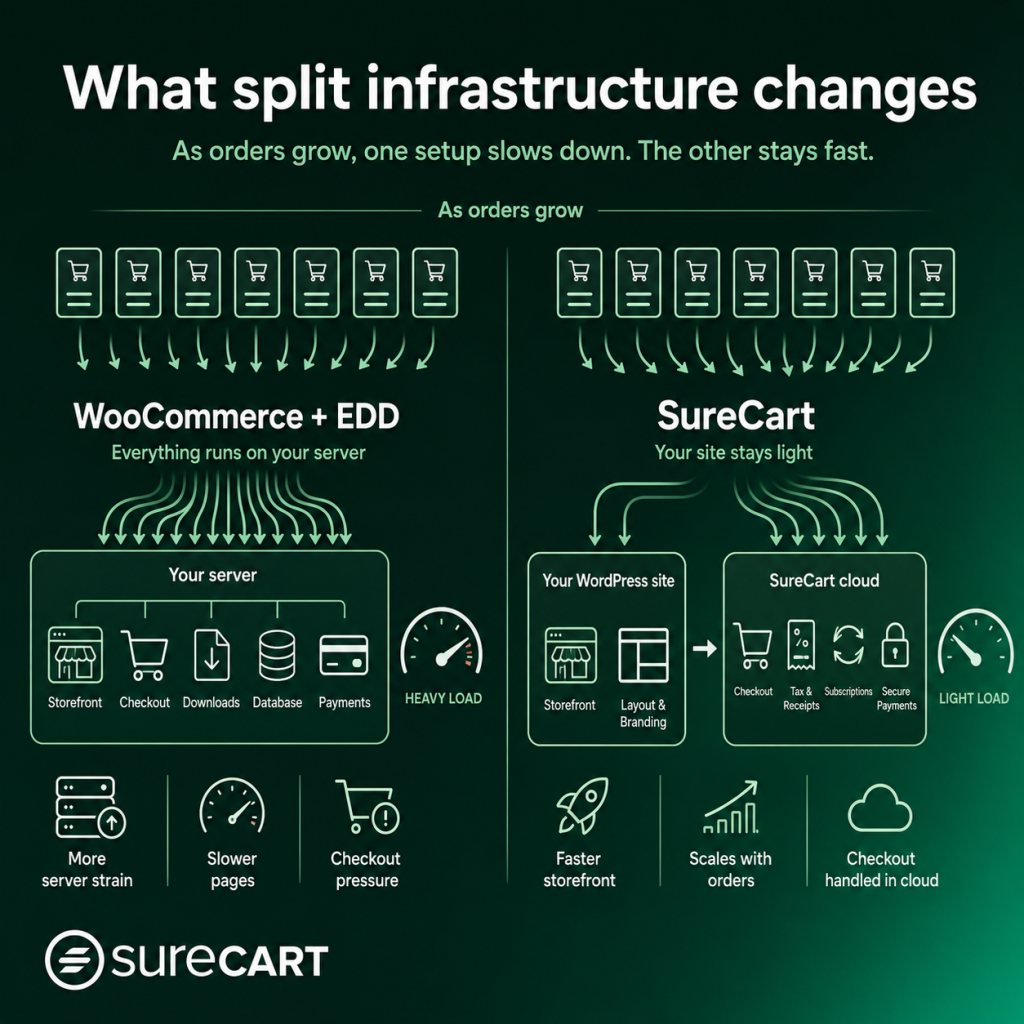
Hosting. The line item people forget to compare. Because WooCommerce and EDD run their checkout and file delivery logic on your own server, a store that grows past a few hundred orders a month, or starts selling large video files can outgrow a basic shared hosting plan and need an upgrade. Our cloud-processed model means hosting needs tend to stay flat as order volume grows, since the transactional load isn’t hitting that server at all.
Why Architecture Matters More Than a Feature List
Feature checklists only tell you half the story. The other half is where the work actually happens.
WooCommerce and EDD are both fully self-hosted. Every checkout, every file download, every order record lives on your own WordPress server and database. You own it completely, and you’re also responsible for it completely: hosting quality, caching, plugin conflicts, all of it.
We split the work differently. Your WordPress site handles what visitors see: product pages, your shop layout, your brand. The transactional load, checkout processing, tax calculation, and subscription billing run on our own servers.
Two practical effects follow from that. Your site’s database stays lighter, so it doesn’t slow down as your order volume grows. And sensitive payment data is handled through the processor’s own secure fields (Stripe’s, for instance), so card numbers never actually touch your WordPress server, which makes PCI compliance simpler for you.
To be fair to the other side, self-hosting isn’t a downside for everyone. If you want direct, low-level ownership of your data and your server environment, and you’re comfortable with the maintenance that comes with it, WooCommerce and EDD give you that in a way our cloud-processed model doesn’t. That’s a real tradeoff, not a flaw.
For a digital product seller running on shared hosting, though, the practical effect of the cloud model is simple: your product pages stay fast whether you sell five orders a month or five hundred, because the part of the transaction that would normally strain a budget hosting plan isn’t happening on that server at all.
What Happens If You Want to Switch Later
Nobody wants to build a store around a platform they can’t leave. Here’s what switching actually looks like, in both directions.
Moving in. SureCart has an eight-step migration path: set up the store, configure branding, connect a payment processor, then import customers, products, purchases, and active subscriptions in that order, each one via CSV. We have a dedicated import guide specifically for moving from WooCommerce, and if you’re using Stripe, saved payment methods can carry over so customers don’t have to re-enter their cards.
Worth being honest about: this is a documented, tool-supported process you (or your developer) run yourself, not a done-for-you migration service. Our own guidance recommends developer help if your store has custom setups or a large amount of data, and our support team can answer questions about how the tools work, but the hands-on data preparation is on you.
Moving out. This is the part people worry about and rarely check in advance. We let you export your full store data, orders, customers, products, subscriptions, charges, refunds, coupons, promotions, as CSV files, at any time, for any reason. If you decide to leave, you can cleanly remove all our plugin data from your site or permanently delete your account entirely. None of your data is trapped.
By contrast, one of the quieter costs of a deep WooCommerce extension stack is that it becomes genuinely hard to leave. Once your checkout, subscriptions, and marketing tools are spread across a dozen interlocking plugins, untangling that later is real work, not a checkbox.
Easy Digital Downloads works with multiple migration plugins or the manual data export and import process, which is time-consuming and needs developer support, or you need to at least have a basic understanding of migration and data preparation to execute it.
What Support Actually Looks Like
Support policies are easy to overstate, so here’s exactly what we commit to in writing, and what we don’t.
SureCart offers ticket-based support around the clock, 24 hours a day, every day of the year. The stated target is a first response within 4 to 5 hours, with full ticket resolution aimed at within 48 hours on weekdays and 72 hours on weekends for licensed (paid-plan) users.
There’s also a team-moderated user community for peer support, and a visible pattern in the public changelog of fast turnarounds on security issues reported by outside researchers.
What it isn’t: there’s no phone line, no live chat, no teleconference support. It’s ticket-based only, and the priority response targets apply specifically to paid plans, not the free Launch tier.
For comparison, WooCommerce’s core plugin is supported through community forums rather than a direct ticket system, and because its paid extensions (Subscriptions, Software Add-on, Product Bundles, Memberships) are built by different developers, each one comes with its own separate support channel.
If something breaks and you’re not sure which extension caused it, you may end up filing tickets in more than one place. EDD’s paid tiers, by contrast, are a single purchase from one company, so support stays in one place, though we haven’t independently verified EDD’s specific response-time commitments the way we’ve verified our own.
What This Actually Costs Per Year
Numbers land better than feature lists, so here are two realistic scenarios, all costs annual, hosting assumed at roughly ₹7,200/year for a standard shared plan on any of the three platforms (WooCommerce and EDD may need a step up as file sizes or traffic grow; SureCart typically doesn’t, since the heavy processing happens off your server).
One thing to flag before the numbers: Razorpay’s own processing fee, about 2.36% effective after GST, applies on top of every total below, no matter which platform you pick, since that’s Razorpay’s cut, not the platform’s. It’s left out of the totals because it’s identical across all three.
Here’s the deal worth knowing about: with the Launch plan currently available through SureCart and Razorpay, we waive our own transaction fee entirely, so you’d pay only Razorpay’s fee and nothing extra to us. That’s an attractive deal, close to a no-brainer if you’re building a business or just trying things out. This is explicitly time-limited. If you’re reading this after July 2026, email support@surecart.com to confirm whether the offer is still valid.
Note: Any dollar-to-rupee conversions in this guide use an illustrative rate of roughly ₹95.5 per $1 (approximate), as of July 2026. Exchange rates move, so treat these conversions as directional, not exact.
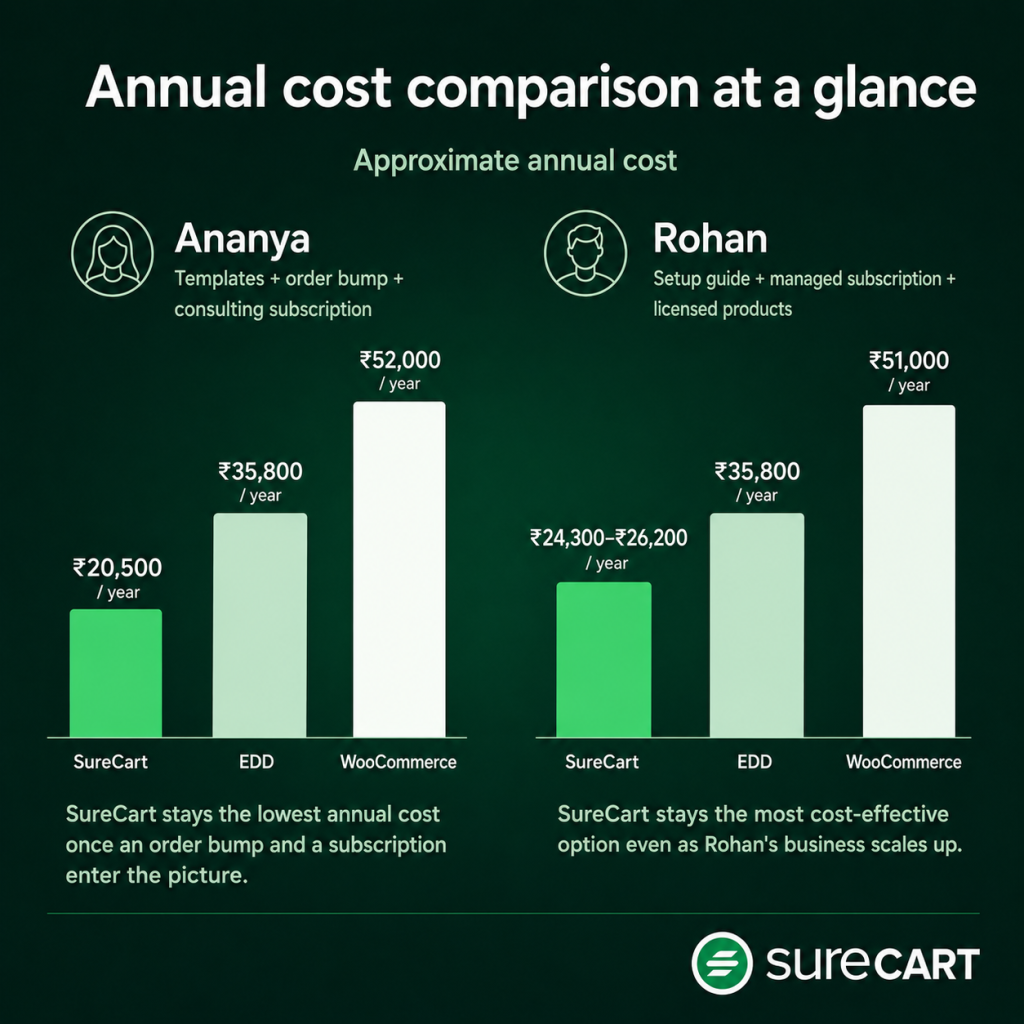
Scenario A:
Ananya is selling Notion templates, a Second Brain setup package as an order bump, and a consulting subscription.
Three revenue lines, not one, so her real question isn’t “what’s free,” it’s “what covers an order bump and a subscription without stacking extensions.”
If Ananya only sold the templates with nothing else attached, WooCommerce’s and EDD’s free cores would still be the more cost-effective way to start; that part hasn’t changed. But her actual business needs a checkout order bump for the Second Brain package and a recurring subscription for consulting, and that’s exactly where the free cores stop being enough.
Say her yearly numbers look like this: ₹499 templates, 200 sales (₹99,800); a ₹2,999 Second Brain setup package taken as an order bump by roughly 40 buyers (₹1,19,960); and a ₹1,999/month consulting subscription averaging 10 active subscribers across the year (₹2,39,880). Total revenue: roughly ₹4,60,000 (about $4,800).
SureCart Launch (free): ₹7,200 hosting, plus a 2.9% fee on that ₹4,60,000, about ₹13,340. Total: around ₹20,540/year, with the order bump and the subscription both included at no extra cost. SureCart Pro instead: ₹7,200 hosting plus $199 (about ₹19,000), no transaction fee. Total: around ₹26,200/year regardless of sales volume.
WooCommerce: ₹7,200 hosting, plus WooCommerce Subscriptions for the consulting tier (₹26,780) and CartFlows or FunnelKit for the order bump (roughly $189, about ₹18,050). Total: around ₹52,030/year.
EDD Professional: ₹7,200 hosting plus $299.50 (roughly ₹28,600), with order bumps and subscriptions both included in that tier. Total: around ₹35,800/year.
Here’s the honest takeaway for Ananya: the moment she adds the order bump and the subscription, SureCart becomes the more cost-effective option by a wide margin, EDD Professional lands in the middle, and a WooCommerce setup with both extensions installed is the most expensive of the three.
Scenario B:
Rohan is selling a one-time AI agent setup guide, a Managed Agents subscription, and his own licensed agent products.
Say his yearly numbers look like this: a ₹2,999 self-serve setup guide, 150 sales (₹4,49,850); a ₹4,999/month Managed Agents subscription averaging 20 active subscribers (₹11,99,760); and ₹9,999 licensed agent products, 80 sales (₹7,99,920). Total revenue: roughly ₹24,50,000 (about $25,650).
SureCart Pro: ₹7,200 hosting plus $179 (roughly ₹19,000), with licensing and subscriptions both included. Total: around ₹26,200/year. Worth repeating here: because we run Rohan’s Managed Agents subscription through our own engine, he skips Razorpay’s usual extra 0.99% recurring-billing charge entirely, a saving he’d still be paying on WooCommerce or EDD using Razorpay’s native recurring feature.
WooCommerce: ₹7,200 hosting, plus WooCommerce Subscriptions for the Managed Agents tier (₹26,780) and the Software Add-on for licensing his agent products (₹17,181). Total: around ₹51,161/year.
EDD Professional: ₹7,200 hosting plus $299.50 (roughly ₹28,600), with licensing and subscriptions both bundled in. Total: around ₹35,800/year. EDD All Access instead: ₹7,200 plus $499.50 (roughly ₹47,700), around ₹54,900/year, for three sites instead of two.
At this level of feature need, SureCart is the most cost-effective of the three by a wide margin; EDD Professional is a reasonably close second; and a fully-stacked WooCommerce setup is Rohan’s most expensive path, unless he needs discounts and upsell features, where he needs to upgrade to EDD’s All Access tier, which costs even more.
Worth sitting with for a second: within Scenario A alone, the gap between selling templates only and selling templates plus the order bump plus the subscription is more than seven times on WooCommerce, going from about ₹7,200 to over ₹52,000 a year, purely because two more features got turned on.
That’s the real cost of the extension model. It’s not that WooCommerce is expensive. It’s that the price is invisible until you need the next plugin.
Which Platform Fits You
Choose SureCart if you want more than just licensing, subscriptions, and bundles. Those three get the most attention in this guide because they matter most to Ananya and Rohan, but they’re a small slice of what we actually include.
We bring in order bumps, one-click upsells, cart recovery, an affiliate platform, invoicing, multi-currency support, and more, and every one of them is unlocked on the free Launch plan, not gated behind a higher tier. Razorpay with UPI works out of the box, too.
Choose WooCommerce if you specifically want full self-hosted control over your data and server, and you’re comfortable with what that costs beyond the free core. It’s not only subscriptions and order bumps that carry a price tag: licensing, product bundles, memberships, GST invoicing, and checkout upsells each come as their own separate extension, often a hefty one, and those costs stack fast as your product line grows past basic downloads.
Choose Easy Digital Downloads if you want an all-in-one WordPress plugin built specifically for digital products, you’re comfortable paying $300 to $500 upfront for a bundled feature set, and you’d rather buy one plan than assemble several extensions. It’s a genuinely solid, purpose-built option, worth flagging one honest tradeoff, though: EDD is the oldest of the three platforms here, and it can show, particularly around newer checkout and conversion features where SureCart and WooCommerce’s actively developed extensions have moved faster.
How to Sell Digital Products in India Without WooCommerce: Step-by-Step
Here’s how this plays out for both Ananya and Rohan, step by step.
Step 1: Pick your platform based on your persona and your cost scenario. Ananya, whose business includes an order bump and a subscription from day one, skips the temptation to start on WooCommerce’s free core, since she’d need to bolt on extensions almost immediately anyway, and picks SureCart instead.
Rohan, who already knows he needs license keys and a subscription tier, picks SureCart Pro rather than assembling separate WooCommerce extensions. If you’re not sure yet whether you’ll need subscriptions or licensing within the next year, assume you will, since switching later means a migration project, not a settings change.
Step 2: Connect Razorpay, and enable UPI, as your primary gateway. Set this up before anything else transactional, and run a small test transaction in test mode before going live so you’re not debugging a payment issue in front of your first real customer.
Step 3: Create your first product and attach your files. Ananya uploads her Notion template files and links a Google Drive folder as backup.
Rohan, whose licensed agent products need activation limits, turns on licensing here too, so each buyer gets a unique key instead of a shareable download link.
Step 4: Choose your pricing type. Ananya sets up three price points: a one-time ₹499 for the template pack, a one-time ₹2,999 for the Notion Second Brain setup package configured as a checkout order bump, and a ₹1,999/month consulting subscription with a short free trial.
Rohan sets up his own three: a one-time ₹2,999 for the self-serve AI agent setup guide, a ₹4,999/month Managed Agents subscription for buyers who want him to handle deployment and upkeep, and a one-time ₹9,999 for each licensed agent product, unlocked with the license key from Step 3.
Step 5: Set up GST-compliant invoicing. As covered above, none of the three platforms has this fully automated yet, so this step needs deliberate research from both Ananya and Rohan, not an assumption that it’s handled. Budget an afternoon for this before you assume you’re launch-ready.
Step 6: Test your entire checkout as a customer would. Every gateway, every product type, before you launch. Do this on your phone using UPI specifically, since that’s how most of your buyers will actually pay.
Step 7: Deliver, manage customers, and know how to handle refunds and access revocation. All three platforms give you this from the order or customer screen. Decide on your refund policy before your first support request forces you to improvise one.
Based on clear numbers and ease of use, the best choice for getting a modern ecommerce experience on WordPress is SureCart.
No feature lock-in, zero upfront cost, no plugin chaos, and the best value for money.
Try SureCart for Free to Get Started
Common Mistakes to Avoid
Assuming Stripe will just work. Plenty of sellers build their entire checkout plan around Stripe, then discover they can’t get an account. Start with Razorpay and UPI as your default, not your backup.
Comparing sticker prices instead of real ones. “WooCommerce is free” is true and misleading at the same time. Look at what you’ll actually need to install to match what SureCart or EDD includes, then compare totals.
Buying EDD’s Professional tier for features you don’t need yet. If you’re just starting out selling one simple product with no order bump or subscription attached yet, EDD’s free core or SureCart’s Launch plan is the more cost-effective choice. Save the $299.50 for when licensing or subscriptions are actually on your roadmap, the way they already are for both Ananya and Rohan.
Skipping the GST question until launch week. None of these three platforms has GST-compliant invoicing fully solved out of the box. However, SureCart can integrate with any GST invoicing platform to solve it for you.
Not testing checkout as a real customer. Whatever you choose, complete a real purchase yourself, on mobile, using UPI, before you tell anyone else your store is open.
See also: SureCart vs WooCommerce: Honest Comparison and How to Sell Digital Products on WordPress for broader, non-India-specific comparisons, and Razorpay vs Cashfree vs PayU for a deeper look at India payment gateway pricing if Razorpay alone doesn’t answer your question.